Thursday, September 30, 2010

Monday, September 27, 2010

McGraw Is The Man For The Job


(Featured in the Moscow-Pullman Daily News September 27th)

I am writing today to address what most would agree to be the key issue in Latah County: jobs.

Latah County Commissioner candidate for the 3rd district, Dave McGraw, is a fourth generation Latah County resident. Dave is a person of outstanding character, strong integrity, and a successful businessman in our County for more than 25 years. Dave knows the sacrifice to make payroll, how to hire and train qualified workers, and where to cut spending. He also knows personally the limits of government red-tape and taxation and the affect these have on commerce. He will be able to place policies on the county level that will enable local business startups to thrive, as well as attract businesses from other areas. Many can agree that Dave has a sound understanding of this county and how much we all care for our futures.

What about Dave’s opponent? Her bio states that she has dedicated the last 29 years as a volunteer in the Peace Corp, traveled the world, and has been a volunteer with several city and university organizations. While these are all honorable life-choices, it is not the background I desire for someone to be successful running any government organization in a recession. Can we turn over the reins of county government to someone that has no solid managerial experience?

If we are serious about turning this great country around, we must do it on the local level. This means putting local leaders that are interested in the growth of business in the county in the proper spots. My vote is for a proven conservative and my friend, Dave McGraw, and I encourage voters to cast a ballot for success and job creation.

Monday, August 30, 2010

Thursday, August 26, 2010

Farm Safety Is Not A Game


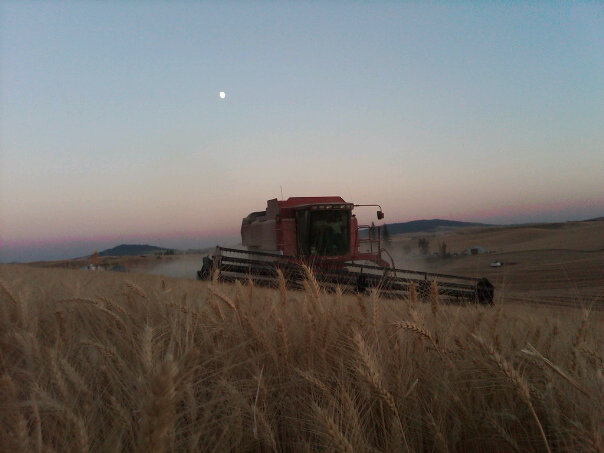
Moscow, ID - As the harvest season winds to a close, I think back on this summer and all that has happened. Although the harvest was successful, there were still moments that would have scared any mother. As the last load of grain went into the last semi to the river, I pondered the importance of farm safety.

In the year 2000 there was a report that claimed that there are, on average, 270 deaths on farms big and small. Even though equipment and efforts have been made in the last 10 years to prevent this number, I am certain when newer numbers come out it will compare. So, here are some things to look for on the farm in all four seasons to help reduce the number of accidents and prevent the unthinkable.

1. Tractor and Combine - Family farming reaches into the very depths of who we are in American farming and in more cases than none the farm wouldn't survive without the help of family both young and old. There are stats out there that contribute 200 of the 270 deaths to some sort equipment operation. These hazards are usually found in roll overs and running someone over. Even with the greatest technological advances a rollover could prove to be very fatal. When I was a young kid around six or seven there was a neighbor, age 14, that was involved in a tractor rollover. The young guy was driving down the road with his fathers tractor spraying weeds I believe when his hat blew off of his head. When he swung back around to catch the hat his tractor veered off the road and over a bank, he did not make it. Other examples of tractor accidents include clothing catching in PTO shafts, catching gear shift handles on dismount, and rolling over by-standers. While each case is unique, there are a few things to do before operating equipment that will assure extra care.

First, always inspect equipment at the beginning of the season and quickly before each season. This will ensure that Roll Over Protection Systems (ROPS), seat belts, and equipment is in tact and in proper working order. It is common for me to find a bolt loose on a ROPS on a tractor and although it isn't anything someone did, such an error can prove to be fatal. Make sure that you are watching for all people in the working radius of the equipment and constantly evaluating your path of motion in order to avoid hazards. Also, a little training prior to the start of the season is a great way to prevent bigger problems. This year one of the hired hands ran a couple semi tires over the tractor bucket at the home storage bins, something that five minutes of training could have saved precious time, money, and frustration.

Second, encourage operators to pay attention to the operation of the equipment they are running. In my opnion, one of the biggest mistakes Russel made in the accident was placing the value of his hat above that of the tractor he was operating and ultimately, his life. Instilling a sense of responsibility in operators and family members to pay attention at all times in which direction the equipment is running and what path it is taking, setting aside the concern for something that can be replaced for less than the cost of a life. Make sure that operators are familiar with equipment before turning them loose, something that is always stunning to see how many farmers don't assure. A combine can cost more than $300,000 and for some reason a fresh operator with no experience is put in the cab and there is wonder when a rollover happens or when a header is stuck in a bank. A half day of operation training may save others and yourself.

2. Home Commodity Storage - Most of us are familiar with the dangers of a PTO shaft and if you are not, this is a moment to mention a little bit about them. I was working on a hog farm a few years back with an older gentleman who some years back had been pumping slurry from a pit in the finishing barn. While he was mounting the back of one of the Farmall tractors, he slipped and fell straddling the PTO shaft. Luckily, the farm worker was strong enough to grab the seat and pull himself up and hold until someone was able to shut the tractor off, but not before breaking bones and tearing his overalls clean off of his body. Consistantly I see farm operators walking up and engaging and disengaging PTOs on tractors from the back end between the tire and the shaft. This is a big "NO-NO" and should be avoided at all times. When you are involved in a home storage operation like the one in the picture, be sure to pay attention at all times to what is happening, keep your hands and clothing clear of all moving parts, and once again, teach the importance of life before the value of a favorite hat, shovel, broom, or sadly, even pens. Augers are nothing to be tangoing with.

3. Trucking and Moving Grain - To some the trucking part of their operation is forgotten. As a long time operator of trucks of all sizes on our farm, I assure you it is very important to keep your trucking and grain cart operations in check. Throughout harvest we hear stories of hired labor putting trucks in ditches, not setting parking breaks correctly, and misuse of truck hoists. I can tell you that the efficiency of your truck driver in all seasons is a deal breaker. If your combine or tractor are sitting for 15 minutes each round trip through out the day, that is 150 minutes in a 10 load day, and in month long harvest that is 3,900 minutes. How many bulk tanks or trips around the field is that?

One of the most common things we see in trucking on farms is, of course, the ditch or running into something. Believe it or not, I have put a truck in a ditch or two, or three, in my lifetime and I have just started. What was it that causes this? I can say from experience it is from being in a rush, not paying attention to the road due to off road distractions or cell phones. Keep a close eye on your operators because a spilt load of grain or fertilizer could mean the loss of thousands of dollars and possibly a life. Make sure you train these drivers as well and walk them through unfamiliar situations, even if they are coming from another farm operation. Time is money and 3,900 minutes is $780 ($12/hr) pay to a driver who made a mistake or didn't do their part to keep the operation moving.

Grain carts are a different situation. Many operations are at the size where a grain cart is pivital to trucker turn around and to keeping that combine moving in the field. Have the operator approve a path prior to taking it, as each operator has a different level of skill or knowledge when it comes to operating on hills or through fields with ditches. Many times we have seen pictures of a grain cart with a full load on a hillside with a tire broken off or overturned. This can be avoided by providing insight and keeping safety at the forefront of your mind.

One of the greatest concerns I have when I am on the farm is of the little kids running around. On any given day on the farm there can be one or two, and sometimes four or five, kids taking in the life experience of the family farm. By the sheer curiousity of their small minds, they try for a closer look, stretch for that extra thrill, or try to be "just like dad." Be aware of this at all times. When I have a young one with me I have them stand off to the side and make them stand there until things are taken care of. The statistics don't say it, but a good share of those 270 deaths on a farm are of young kids who are operating equipment or riding along. Be safe and treat those kids like the golden goose egg you don't want to break. I like to make sure that the kids know not to touch any buttons in the truck or tractor until at least age 10 or 12. When I am out of the truck, they are too and they stand where I can see them at all times. Take time to teach your young ones about the machinery and what it does, the best way for them to understand why its not safe is by explanation.

Take these few tips and apply them to your operation and see how much difference there is. Life is so precious and although I did not hear of any deaths here on the Palouse this year yet, I know somewhere in America there was and someone is hurting because of it. Keep safety as the top priority and you will be able to enjoy that fall BBQ with everyone and every finger and toe accounted for.


(Photo Credit: Mike Friddle)

Thursday, May 20, 2010

Giant Palouse Earthworm

The second chance of an enlistment of the ever so famous “Giant Palouse Earthworm,” very well has come to a stop with the finding of five worms on Paradise Ridge. The find, stumbled upon by a University of Idaho graduate student, just happened to fall on the first day of search with a tool that the UI recently got its hands on.

According to the UI professor, Dr. Jodi Johnson-Maynard, the worms were found within the top 7 to 10 cm of top of soil. Maynard, who is a professor who routinely performs research in organic soil matter, said this finding completely changes all they knew about the once mythical worm. According to word of mouth tales, the worm was supposed to be up to three feet in length, white, spitting, and smell like lilies, none of which were prevalent in the discovery.

The finding comes with interesting timing, as a petition was filed by Palouse Prairie Foundation, Friends of the Clearwater, and many other groups and individuals with environmental activist agendas in June of 2009. Almost a year after the petition was filed by the signed groups and individuals, the United States Department of Fish and Wildlife is still yet to come to a decision to file the mysterious worm. The petition, which is short relative to the petition filed in the case of the Polar Bears, cited many factors as a threat to the habitat of the worm, most of which are environmental activist buzz words such as herbicides, livestock grazing, and urban sprawl. The petition is often seen as a short and rushed document, full of accusations and lacking in fact and scientific base.

When I had the opportunity to sit down with Dr. Johnson-Maynard in regards to the finding, it was made clear that neither her, nor her researchers, had anything to do with the petition, making the implication that the science is not behind such an accusation. This brought great comfort in my interview with her. The worm, which has been sought after by many on the Palouse, caused a great deal of interest from people all over the world, and as the phone rang from a caller in Chicago, Illinois, we dove right into the worm and the basics of the finding. The worm was actually only 8 inches when they stretched it to full length, and this was not the juvenile. Worms typically come to sexual maturity within a year to a year and a half, and this worm was well into that process with one juvenile and three cocoons laid within inches of the so called adult. The worm was immediately shipped to a program in the mid-west for identification as they were taken by surprise when they found five of these species right there in the top soil. The adult came back dissected, but provided a great foundation for the research of this new worm, with most attention to the broad spread of DNA markers, which match the worm to many other species found within the US, including a bunch of worms found recently in Leavenworth, WA.

After talking about the bust of many myths and actually hearing her admit that all the previous knowledge of the worm was strictly from word of mouth recollections and that there was no specific scientific backing, we moved to the issues. I will make the claim now: my family farms here on the Palouse and I do have a vested interest in the worm and the research. With that, please know I want them to find as many of these stinking worms as they possibly can and I hope they don’t stop until they have more worms than fish they can pull out of Spring Valley and Moose Creek.

Soil Type: It has been speculated as to the type of soil the worm could survive in, claimed that the worm would only be able to live in a native habitat. The supporters of the theory say that the only way we can provide a living habitat is to have an area solely designated as natural soil and that there is to be no threats of contamination. At a forum hosted by the Latah and Whitman County Farm Bureaus, the idea of a National Preserve was suggested by the president of the Palouse Prairie Foundation, David Hall. When I asked about this, Dr. Johnson-Maynard said that there needs to be more research to this and that the findings were in peculiar places that really make this accusation questionable.

Livestock Grazing: This ties into the above very close. We talked a little bit about the methods of grazing and the role that livestock play in the development of the soils ability to be livable. In livestock grazing, there are several ways you can look at impact that the animals have on the environment, and one of the most overused phrases in the environmental playbook is overgrazing. Overgrazing is when a farmer or rancher keep their animals on a piece of pastureland longer than the foliage threshold can stand. Threshold for grazing is based off of factors including the type of plants, soil type, climate, access to moisture/rainfall, and the type of animals grazed on the land. A land that has cattle versus sheep on it, with native grasses versus legumes or weeds growing on it, has access to 21 in. of rain or irrigation versus drier climates, and is a silty loam versus a sandy clay type soil, typically have a higher threshold. The claim by environmentalists is that all farmers and ranchers keep their animals on the land longer than it is necessary and therefore livestock grazing is an immediate threat to this worm’s habitat. While this may be true with a few ranchers, this is not the case. The only threat that Dr. Johnson-Maynard could cite from livestock grazing was if an animal ate all the plants and trampled the ground solid.

Herbicides: Pesticides have been under constant scrutiny since the U.S. Environmental Protection Agency was formed in 1970. Since then, there have been major developments in the chemicals we use on our crops and in our buildings and homes, that are hands down safer for both humans, and the environment. The EPA has strict guidelines for the listing and registering of pesticides, and it can take up to ten years in some cases for a chemical to be listed as legal and safe for sale to licensed applicators, no less than six years of study per chemical released. A common misperception that a lot of environmentalist and people who are uneducated on the development of chemicals have is that a chemical can be released without extensive research due to a company’s weight in the political ring. This is completely ignorant and lacks facts all together. Listing and researching pesticides are the two single things that the EPA can only do right. When I addressed this issue I was expecting to hear a long list of chemicals that attack systemically, but I was proven wrong. The only chemical that was named was Sevin, which is an organophosphate (4F Carbaryl), and is used in vegetables, nut trees, and vine and tree fruits for the control of beetles, weevils, and worms. Sevin, which is produced by the Bayer Corporation and retailed mainly to homeowners in town, as well as used by the Orkin man, is not typically used in agriculture, and judging by the registered crops, not used by Palouse farmers. The commercial form of Sevin, Sevin XLR, has a residue that will not wash very easily and after a good rain, still works to fight the bugs. This implicates that the runoff and leaching tendencies of the crop are minimal and, if used properly, don’t have an immediate effect on the Giant Palouse Earthworm. When I pressed her to see if she had any reserve for other chemicals that might affect the worm, she simply said the only other one she could think of was one we use on aphids, adding that there hasn’t been any research on that accusation though.

The worms, as we continued conversation with the affects of farming on its habitat, at this point, look to not be a big issue at all. From what I could see there is still a great deal to learn about this worm and how we affect it truly. The next steps with the development of the knowledge base are pretty basic and will continue as any other species. There will have to be a search for funding, but the next immediate step is to find other locations of habitat. A flower patch on Paradise Ridge is simply not a large enough search. There is a waiting list of land to be searched and for now they will wait to search on those pieces of land, all while trying to pin down the exact genetic markers that make it the GPE. What I found to be the most interesting part of the conversation was toward the end when we touched on the survival of the worm. Apparently this worm over produces leaving a larger population than the year prior, which is not normal worms of this genesis.

My hope is in the fact that there simply isn’t enough science to protect it under the Endangered Species Act, or that there is enough to prove that there are more and back to the drawing board we should go. The deepest concern I have is a political one. Obviously there is a deep tap root of environmental ideology involved and it will take a lot to battle it. If you look hard enough you will find that the first petition that was filed in 2007, the one that was rejected, was filed during the era of former Interior Secretary, Dirk Kempthorne, of Idaho. Why is that so strange you ask? The Interior Secretary is involved with many environmental deals in the U.S. and oversees the research and decision making when it comes to the Endangered Species Act. In my research I found that Kempthorne put the least amount of animals onto the list than any other Interior Secretary in history. Read that again, IN HISTORY. That is from the start of this country, a man from Idaho was in charge of the ESA and the Endangered Species List and he was conservative as expected. Although I agree with his style, it makes complete sense what is happening here. Is it ironic that the second petition was submitted after his term was over? I know you are smarter than that, especially if the petition that could hurt farming the most comes from a bunch of hippies in Idaho. The current administration could very well go either direction with this one.

The facts show there isn’t a foundation for this petition other than empty words that have been talking points of uneducated people for many years now. I am a fan of science and the more I get into agriculture and my job as a support scientist, the more I see that scientific backing is important to many decisions. The worm’s future is up in the air right now, and so is ours. I encourage you to consider what is here and go search it for yourself, what would it hurt? Just keep this in mind, before I left the office I asked her one more time to make sure it was stated clear and she responded, “The only real threat I can see from farming is from those who use conventional type farming practices. The over tillage can destroy burrows in the top of the soil.” It’s a breakthrough, but aren’t we already moving towards no-till anyways?
Related Posts Plugin for WordPress, Blogger...